
How Does Ayurveda Help to Treat Trigeminal Neuralgia?

According to this shloka, symptoms of Anantavata are:
When there is a vitiation of all the three doshas, a person will experience pain in the neck region. These vitiated doshas get accumulated in the eyes, forehead, cheeks and cause severe pain in the facial nerves.
Reference: Sushrut samhita (uttar tantra): Chapter-25 and shloka-13)
What Is Trigeminal Neuralgia?
As Per Ayurveda Aspect
It is correlated to “Ananta Vata”. In this condition, there will be intense pain at manya (carotid artery region), near cheeks, back of neck and eyes. All three doshas are involved in this condition. It may be either Vata alone or Vata dosha along with Kapha dosha when getting aggravated cause pain like cutting and churning in the half region of the face, eyebrow, ear, neck, and forehead. This type of pain develops at the interval of a fortnight or a month and then usually subsides on its own.
As Per Modern Aspect
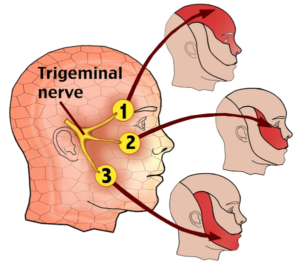
The brain is connected to the body by the spinal cord through spinal nerves which send and receives impulses and messages from and to the brain. There are twelve cranial nerves that are directly connected to the body and are involved with the muscles and sensory functions of the head and neck. Trigeminal neuralgia is described as the most excruciating pain known to humanity. It is the inflammation of the trigeminal nerve which causes intense facial pain. The pain is intense and may occur after every few seconds, hours and minutes. There can be a period of months or years between the attacks but in some patients whose pain is not under controlled can cause chronic pain syndrome that affects the activities of daily life and also causes depression.
What are the Causes of Trigeminal Neuralgia?
- The main cause of trigeminal neuralgia is not known. It is mainly idiopathic (unknown cause).
- Some inflammatory causes are sarcoidosis, multiple sclerosis, and Lyme disease.
What are the Symptoms of Trigeminal Neuralgia?
- Acute onset of sharp, severe and stabbing pain on one side of the face and can be worsened by chewing, light touch and cold exposure in the mouth.
- Pain tends to begin at the angle of the jaw and radiate along the junction lines.
- Affected areas are jaw, teeth, cheek, lips, gums, or less often the eyes and forehead
- Attacks become more intense and frequent over time.
- Burning sensation in the affected area that may occur before it evolves into the spasm.
- Pain focused in one spot or may spread in a wider pattern.
- The person will rub or hold the face to ease the pain
- After the first attack, the pain may subside for months or even years.
How Ayurveda Helps To Treat Trigeminal Neuralgia?
Planet Ayurveda is offering trigeminal neuralgia care pack and this pack is prepared from using best quality herbs. These herbs are 100% natural and pure. These are free from preservatives, chemicals, and additives.
This Product Contains
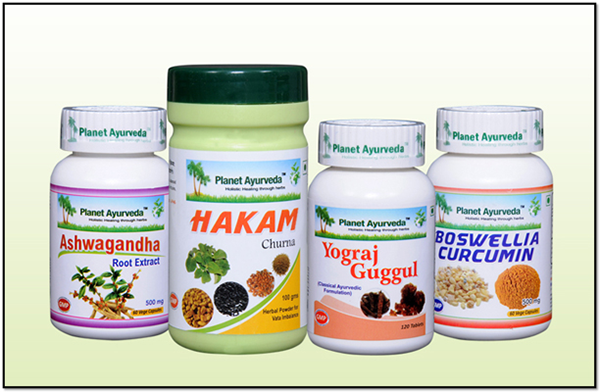

1. Ashwagandha Capsules
Ashwagandha is a natural and effective herb used in Ayurveda for many years. The main function of this herb is to treat stress and neurologically related disorders. It maintains the hormonal imbalance and reduces anxiety, mood swings, and hot flushes. Being an anti-oxidant, anti-anxiety and hypoglycemic, it is useful in treating diabetes. It is widely useful in treating depression, chronic fatigue and anxiety because it has a calming effect on the brain. If used externally in the form of paste or oil then it is used to relieve pain, inflammation, and swelling.
Dosage: 1 or 2 capsules twice daily with plain water after meals.
2. Hakam Churna
Hakam churna is an effective herbal remedy formulated by Planet Ayurveda which is very useful for trigeminal neuralgia. This formulation contains authentic and pure herbs such as methi (Trigonella foenum graecum), chandershoor (Lepidium sativum), kalonji (Nigella sativa) and ajwain (Trachyspermum ammi). The unique combination of these herbs acts as an anti-spasmodic and is responsible for various metabolic processes. This churna enhances liver function and improves the digestive fire. It has an anti-inflammatory action on the body that helps in relieving chronic conditions such as sciatica, osteoarthritis, rheumatoid arthritis, trigeminal neuralgia, and cervical spondylitis.
Chandershoor
This herb is one of the best anti-Vata herbs in Ayurveda and has the best nutritive value. It pacifies Vata as well as Kapha dosha, leading to instant pain relief.
Fenugreek
Seeds of fenugreek have been used as a spice and its fresh leaves are consumed in the form of vegetable in India in treating indigestion, flatulence and sluggish liver.
Kalonji
Kalonji is commonly known as black cumin and seeds of this herb are used in India for improving the digestion process. Its seeds have diuretic, stimulant, carminative and anthelmintic properties and it also pacifies Vata Dosha.
Ajwain
Ajwain is used as a common spice and has a property to pacify Vata Dosha. Seeds are effective in relieving body pain and stiffness and painful menstruation.
Dosage: 1 teaspoon twice daily with plain water after meals.
3. Yograj Guggul
Yograj guggul is an herbal formulation comprised of effective ingredients such as devdaru (Cedrus deodara), shudh Guggulu (Commiphora mukul), haritaki (Terminalia chebula), Amalaki (Emblica officinalis), pippali (Piper longum), chitraka (Plumbago zeylanica), jeeraka (Cuminum cyminum), ela (Elettaria cardamomum), adraka (Zingiber officinale) and mustaka (Citrus rotundus). This formulation is widely used in the treatment of vata and Kapha disorders. This painful condition of facial muscle is accompanied by burning sensation, stiffness, inflammation and limited facial movement and mobility. So, yograj guggul is used in reducing pain, swelling, inflammation and flushes out the harmful toxins from the body. It has immuno-modulatory and rejuvenating properties which help in the regeneration of tissues.
Dosage: 2 tablets twice daily with plain water after meals.
4. Boswellia Curcumin
Boswellia curcumin is a wonderful herbal formulation that has curcumin (Curcuma longa) and shallaki (Boswellia Serrata) in it. This formulation has one of the most effective combinations of anti-inflammatory and analgesic herbs. These herbs not only improve the flexibility but also increase the circulation in the body and promote the overall health of a person.
Turmeric
Turmeric has been used in Ayurveda since many ages for a wide variety of conditions and diseases such as acne, wounds, sprains, pain and its strong antioxidant action removes toxins from the body.
Shallaki
Shallaki is an effective Ayurvedic plant that contains anti-inflammatory compounds and its extract is used in many anti-inflammatory conditions such as the lumbar spine, osteoarthritis, rheumatoid arthritis, and trigeminal neuralgia. This herb also prevents the breakdown of surrounding connective tissues and suppresses the growth of inflamed tissues.
Dosage: 1 or 2 capsules twice daily with plain water after meals.
